
At a glance
- Battery passport required
- Feb 18, 2027
- Batteries in scope
- EV, LMT, industrial > 2 kWh
- Not one per model
- One per battery
- Public, legitimate interest, authorities
- 3 access levels
From February 18, 2027, every EV battery, light means of transport battery (e-bikes, e-scooters) and industrial battery over 2 kWh placed on the EU market needs its own battery passport: one per battery, opened with a QR code and registered in the EU DPP Registry. Most of the data doesn’t come from the brand. It sits in your cell supplier’s datasheet and material declaration, your test lab’s cycle-life report, your compliance team’s declaration of conformity, and your own product and service data. The due diligence report follows in August 2027; carbon footprint and recycled content come later.
Which batteries need a passport
Article 77 of the Battery Regulation covers three categories: EV batteries, light means of transport (LMT) batteries (e-bikes, e-scooters, e-mopeds) and industrial batteries with a capacity above 2 kWh, such as home and commercial energy storage. Portable batteries, SLI batteries and industrial batteries of 2 kWh or less don’t need one.
The obligation sits with the company that places the battery on the EU market, usually the manufacturer or, for batteries made elsewhere, the importer. If you sell e-bikes with a battery made by someone else, check who that is for your batteries: often it’s you.
Where every battery passport field comes from
Each row is a document you can ask for today, who usually has it, the passport fields it fills (Annex XIII) and who can see them.
| Document | Fills in the passport | Access |
|---|---|---|
| Technical datasheet (the full spec, not the sales sheet)Cell supplier | Battery chemistry, rated capacity, minimum, nominal and maximum voltage, original power capability and limits, internal cell and pack resistance | Public |
| Material declarationCell supplier | Hazardous substances other than mercury, cadmium and lead, critical raw materials above 0.1% w/w, detailed composition of cathode, anode and electrolyte | PublicLegitimate interest |
| Safety data sheetCell or pack supplier | Usable extinguishing agent | Public |
| Cycle-life test reportTest lab or cell supplier | Expected lifetime in cycles, the reference test used, the C-rate of that test, initial round-trip energy efficiency and at 50% of cycle life, capacity threshold for exhaustion (EV batteries) | Public |
| Test reports proving complianceTest lab, compliance team | Links to the reports behind your declaration of conformity | Authorities only |
| EU declaration of conformityCompliance team | A link to the declaration. Keep the URL stable so new versions don't break passports already in circulation | Public |
| Label artworkCompliance or packaging team | The meaning of the labels and symbols on the battery | Public |
| Take-back scheme informationCompliance team, take-back scheme | Prevention and management of waste batteries: how users return them and who collects them | Public |
| Product master dataProduct team (PIM or ERP) | Battery category, manufacturer, place and date of manufacture, weight, commercial warranty for calendar life, temperature range when not in use | Public |
| Repair and dismantling documentsService or aftersales team | Spare part numbers and where to get them, dismantling information, safety measures | Legitimate interest |
| Serial numbersProduction | A unique identifier for every individual battery, carried by its QR code | Public |
Start with your cell supplier. Their data sits one or two steps up your chain, so it’s the slowest to get. Cycle-life tests often already exist at cell level, so ask them before booking a lab.
What’s due when
Not every field is required on day one.
Feb 18, 2027
The battery passport goes live
Every EV battery, light means of transport (LMT) battery and industrial battery over 2 kWh placed on the EU market needs a passport, reachable through a QR code on the battery. All fields in the table above are required from this date.
Aug 18, 2027
Supply chain due diligence
The due diligence policy report is added to the passport as a link.
Set per category
Carbon footprint
Carbon footprint per kWh, the performance class (A to E) and the carbon footprint declaration (Article 7). Each battery category gets its own date through a delegated act, so the field stays empty until then. The data starts with your cell supplier, so ask early.
Later
Recycled content
Shares of recycled cobalt, lithium, nickel and lead (Article 8), from a later date set in the regulation and its acts.
Who can see what in a battery passport
Annex XIII splits the passport into three access levels. This matters when you ask suppliers for data: a supplier shares composition data much more easily once they know it won’t be published.
Anyone who scans
General information, chemistry, performance and durability, hazardous substances, critical raw materials, labels and the declaration of conformity.
Repairers, recyclers and others with a legitimate interest
Detailed composition, spare parts, dismantling information and safety measures. An EU implementing act sets exactly who qualifies.
Market surveillance authorities
The test reports that prove the battery complies.
Checklist: what to ask your cell supplier this week
- 1
Full technical datasheet for every cell model
Including internal resistance and power capability, not just capacity and voltage.
- 2
Cycle-life test report
With the reference test and the C-rate written out.
- 3
Detailed composition
Cathode, anode and electrolyte. Tell them it stays restricted in the passport.
- 4
Hazardous substances and critical raw materials
Anything above 0.1% w/w.
- 5
Current safety data sheet
For the extinguishing agent and handling notes.
- 6
Carbon footprint data
Not due on day one, but it starts with them.
How to get it done before February 2027
- List every battery model you place on the EU market and check its category: EV, LMT or industrial over 2 kWh.
- Send the checklist above to each cell and pack supplier, and agree up front which data stays restricted.
- Collect your own data: product master data, label artwork, declaration of conformity, take-back details and repair documents.
- Make sure production gives every battery a serial number that can go into a QR code.
- Choose how the passport is created, hosted and registered in the EU DPP Registry, and test it with a few batteries before the deadline.
Veribl collects supplier data through supplier requests, builds the passport with all three access levels and prints a QR code per battery. See battery passports in Veribl.
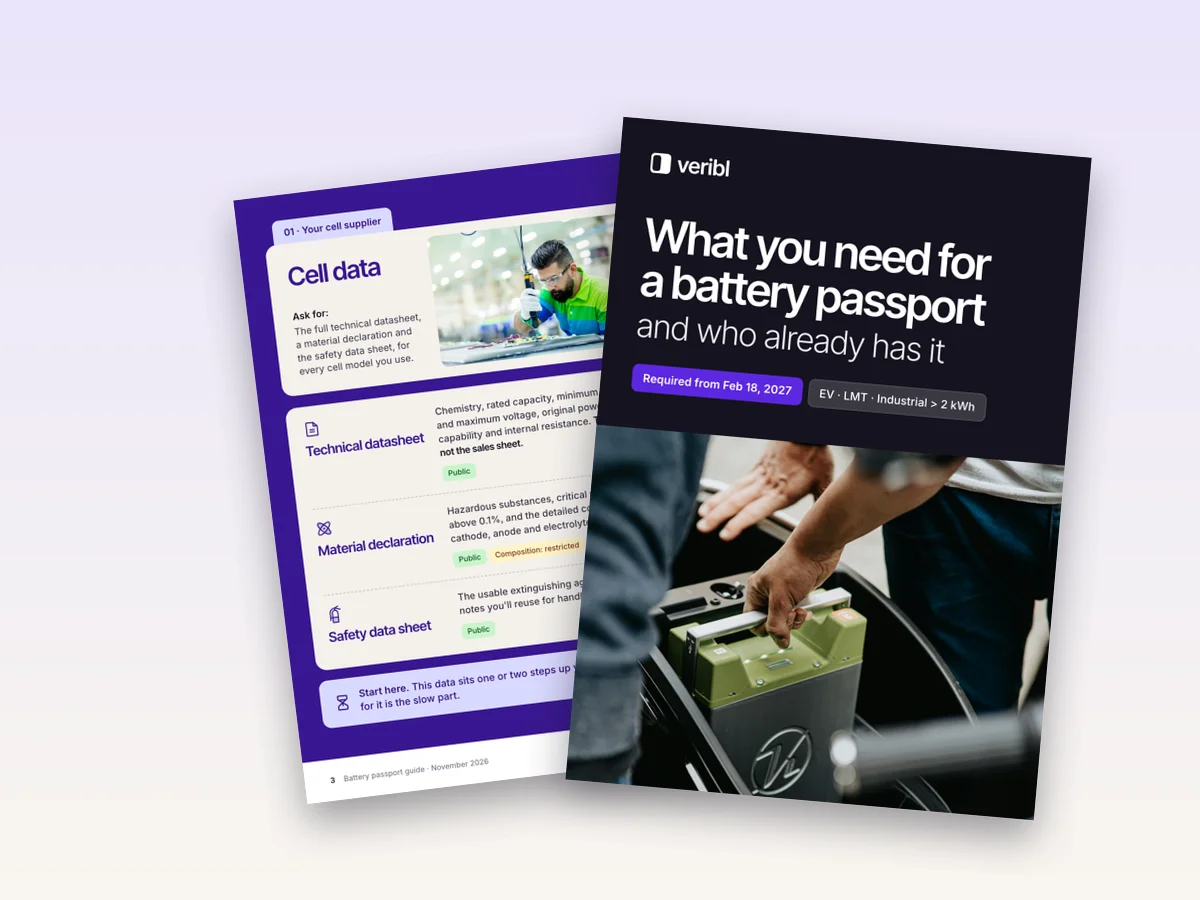
Take this guide with you
The same map as a 10-page PDF, with a checklist to forward to your suppliers.
Get the guideFrequently asked questions
What is a battery passport?
A battery passport is a digital record for an individual battery, required by the EU Battery Regulation (EU) 2023/1542, Article 77. It holds information about the battery's manufacturer, chemistry, composition, performance, durability, carbon footprint and end of life, and it's opened by scanning a QR code on the battery. It is the first digital product passport with a fixed date in EU law.
When is the battery passport mandatory?
From February 18, 2027. From that date, every battery in scope placed on the EU market needs a passport, including batteries made outside the EU. Some fields follow later: the due diligence report from August 18, 2027, and carbon footprint and recycled content from dates set per battery category.
Which batteries need a battery passport?
Three categories: electric vehicle (EV) batteries, light means of transport (LMT) batteries such as e-bike and e-scooter batteries, and industrial batteries with a capacity above 2 kWh. Portable batteries, starting, lighting and ignition (SLI) batteries and industrial batteries of 2 kWh or less don't need one.
Who is responsible for the battery passport?
The economic operator that places the battery on the EU market. That's usually the manufacturer, or the importer for batteries made outside the EU. They can work with a service provider to create and host the passport, but the responsibility stays with them, even though most of the data comes from suppliers.
Does every battery need its own passport?
Yes. The passport is linked to a unique identifier for each individual battery, not to the battery model. Model-level data such as chemistry or rated capacity can be shared across a series, but every unit gets its own passport, identifier and QR code, and is registered as its own entry.
What data goes into a battery passport?
Annex XIII of the regulation lists it. In short: general battery and manufacturer information, compliance and labels, materials and composition, carbon footprint, supply chain due diligence, circularity (recycled content, spare parts, dismantling, safety) and performance and durability (capacity, voltages, power, cycle life, efficiency, internal resistance). The table on this page maps each of these to the document it comes from.
Who can see the data in a battery passport?
There are three access levels. General information, chemistry, performance, hazardous substances, critical raw materials, labels and the declaration of conformity are public. Detailed composition, spare parts, dismantling information and safety measures are only for people with a legitimate interest, such as repairers and recyclers. The test reports proving compliance are only for authorities.
Is the carbon footprint required from day one?
No. The carbon footprint declaration, performance class and value under Article 7 apply from a date set separately for each battery category by delegated acts. Until that date the field can stay empty. Because the calculation depends on data from cell suppliers, it's worth starting the conversation now.
Is the battery passport the same as the ESPR digital product passport?
They are related but come from different laws. The battery passport comes from the Battery Regulation and has a fixed date, February 18, 2027. The ESPR digital product passport covers other product groups, such as textiles and steel, and only becomes mandatory once a delegated act for that product group is adopted. Both use the same EU DPP Registry and the same idea of a QR code that opens the product's data.
Official sources
- Regulation (EU) 2023/1542 concerning batteries and waste batteries (EUR-Lex)
- Batteries: European Commission
This guide is general information, not legal advice. Confirm the rules for your batteries with the official texts. More: e-bikes and batteries, DPP glossary, ESPR DPP requirements checklist, textile passport requirements.
