
At a glance
- Textile passport mandatory
- Not yet
- Textile rules adopted under ESPR
- 2027 (planned)
- First textile passports due
- Around 2028–29
- Parts already required today
- EU + France
The textile digital product passport isn’t mandatory yet. Its rules are planned for adoption under ESPR in 2027, and brands would comply about 18 months later, so around 2028–2029. But part of what it’s expected to hold is already required: fibre composition on every EU label, and production countries, recycled content and hazardous substances in France. The hardest data sits with your mills and factories, so brands that start collecting it now won’t be rushing later.
What’s already law, and what’s next
Four rules already apply to clothing and textiles. The passport itself is still planned.
Since 2012
Applies nowEU Textile Labelling Regulation
Fibre composition on a durable label for every textile product sold in the EU (Regulation (EU) 1007/2011).
In force
Applies nowFrance: AGEC product information
Brands selling in France publish the country of each production step, recycled content, hazardous substances and, for mostly synthetic garments, a microfibre statement.
Jul 19, 2026
Applies nowNo destroying unsold clothes
Large companies can no longer destroy unsold apparel, clothing accessories and footwear, with limited derogations (Delegated Regulation (EU) 2026/296). Medium-sized companies follow in 2030.
Sep 27, 2026
Applies nowGreen claims need proof
Vague environmental claims such as “eco-friendly” are banned unless you can back them up (Directive (EU) 2024/825).
2027 (planned)
PlannedTextile passport rules adopted
Textiles and apparel are a priority group in the Commission's ESPR Working Plan, with adoption planned for 2027. The date is indicative, not a deadline.
Around 2028–2029
PlannedTextile passport required
An ESPR delegated act applies no earlier than 18 months after it enters into force, so the first textile passports are due around 2028–2029 at the earliest.
Where every part of a textile passport comes from
Each row is a document you can ask for today, who usually has it, what it covers, and whether it’s already required.
| Document | What it covers | Status |
|---|---|---|
| Tech packProduct team | Fibre composition in percent for every material, including linings and trims, and the product type | EU law todayExpected in the passport |
| Care labelProduct team | Care instructions, the fibre label, and non-textile parts of animal origin such as leather patches | EU law todayExpected in the passport |
| Product identifiersProduct team (PIM or ERP) | Style, colorway and GTIN. The rules will set whether a passport is per model, per batch or per item | Expected in the passport |
| Supplier map per production stepTier 1 factory and the mills behind it | Who did each step and in which country: weaving or knitting, dyeing and printing, making | Required in FranceExpected in the passport |
| REACH declaration and chemical test reportMills, chemical test lab | Substances of very high concern, tested against your restricted substances list | Required in FranceExpected in the passport |
| Scope and transaction certificates (GRS, GOTS, OCS)Suppliers, certification body | Proof of recycled or organic content for each shipment | Needed for green claims |
| Physical test reportsTest lab, QA team | Pilling, abrasion, seam strength and dimensional stability after washing | Expected in the passport |
| Colourfastness test reportsTest lab, QA team | Colourfastness to washing, rubbing and light | Expected in the passport |
| Microfibre statementProduct or sustainability team | For garments more than half synthetic: that they release plastic microfibres when washed | Required in France |
| Recycled content per materialSustainability team | The share of recycled fibre in each material, backed by certificates | Required in FranceExpected in the passport |
| Material mix and trimsProduct and sustainability teams | Recyclability: blends, trims and anything that has to come off before recycling, such as zips, buttons and prints | Expected in the passport |
| Repair and care guidesAftersales or customer service | How to wash and repair the garment, and where to get spare buttons or zips | Expected in the passport |
Start with the supplier map. Your tier 1 factory knows its own step; the mills behind it are the slow part, and every brand they make for will soon ask the same questions.
What we know, and what the rules will decide
No textile delegated act has been adopted yet. Based on the ESPR preparatory work, some contents are close to certain and some are still open.
Fibre composition
Already on every label.
Where it was made
Each production step, as France already asks.
Durability
Test results rather than marketing claims.
Recyclability
The material mix and how the garment comes apart.
Model, batch or item
One passport per style, per production batch or per garment.
Which data is public
And what only authorities or recyclers can see.
Where the code goes
On the care label, the hang tag or both.
Environmental footprint
Whether a footprint value is required, and with which method.
Collect the first column now. It’s useful before the passport is required: for France, for green claims, and for your own product pages.
Checklist: what to ask your suppliers this month
- 1
Who made it, and where
Weaving or knitting, dyeing and printing, making: company and country for each step.
- 2
Fibre composition per material
Including linings, trims and threads.
- 3
REACH declaration and chemical test report
Substances of very high concern, against your restricted substances list.
- 4
Certificates for every claim
The scope certificate plus a transaction certificate per shipment.
- 5
Recycled content per material
As a share of the fibre, with the proof.
- 6
Durability test reports
With the test method written next to each result.
How to prepare before the rules land
- Map your suppliers for every production step and country, starting with your best-selling styles.
- Send the checklist above to your factories and ask them to pass it to their mills.
- Gather what you already have: tech packs, care labels, QA test reports and certificates.
- Keep style, colorway, batch and GTIN linked, so you can work per model, batch or item.
- Put the data to work now: France’s product information, proof for green claims, and care and repair pages behind a QR code.
Veribl collects supplier data through supplier requests and turns it into textile passports and care pages on one QR code. See Veribl for textiles and apparel.
Take this guide with you
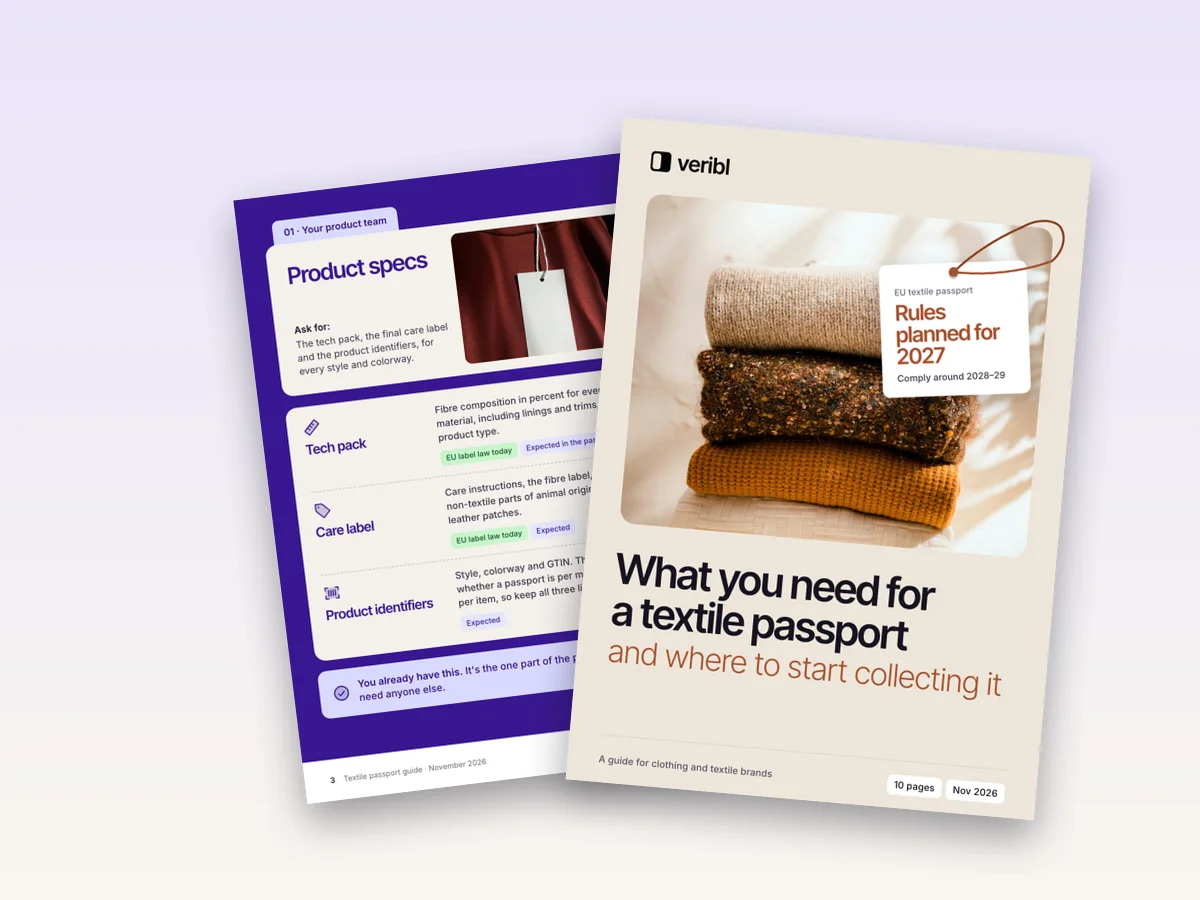
The same map as a 10-page PDF, with a checklist to forward to your suppliers.
Get the guideFrequently asked questions
Is the digital product passport mandatory for textiles?
Not yet. The textile passport will come from a delegated act under the Ecodesign for Sustainable Products Regulation (ESPR), and as of November 2026 no textile delegated act has been adopted. The Commission's Working Plan plans its adoption for 2027, and it applies no earlier than 18 months after it enters into force, so around 2028–2029 at the earliest.
What will a textile digital product passport contain?
The exact list comes with the delegated act. The preparatory work points to fibre composition, where each production step took place, substances of concern, recycled content, durability, care and repair information, and recyclability. Part of this is already required today by the EU Textile Labelling Regulation and by France's AGEC law.
Does the textile passport replace the care label?
Not under the current rules. The Textile Labelling Regulation still requires fibre composition on a physical label. The passport adds a digital record behind a data carrier, such as a QR code, which can hold far more than a label: origin, durability, repair guides and end-of-life information.
Who is responsible for a textile product passport?
Under ESPR, the manufacturer: the company that makes the product or has it designed or made and sells it under its own name or trademark. For a fashion brand that outsources production, that's the brand. If the manufacturer is outside the EU, the importer has its own obligations to check the passport is there.
Does the textile passport apply to clothing made outside the EU?
Yes. ESPR applies to products placed on the EU market, wherever they are made. A brand importing garments from Asia will need passports for them like any EU-made product, which is why supplier data is the hard part.
Will every garment need its own passport?
That's still open. The delegated act will set the granularity: per model, per batch or per individual item. Keep style, colorway, batch and GTIN linked in your data so you can work at any of those levels.
What can a clothing brand do now?
Map your suppliers for each production step, collect fibre composition, chemical declarations and certificates, and keep durability test results with their test methods. This data is useful before the passport is required: France already asks for part of it, and the green-claims rules require proof for any environmental claim you make.
What does France's AGEC law require for textiles?
Brands selling clothing and textiles in France must provide product information including where the main production steps took place (weaving or knitting, dyeing and printing, making), recycled content, the presence of hazardous substances, and for mostly synthetic products a statement that they release plastic microfibres when washed.
Official sources
- Regulation (EU) 2024/1781, Ecodesign for Sustainable Products (EUR-Lex)
- Regulation (EU) 1007/2011 on textile fibre names and labelling (EUR-Lex)
- Directive (EU) 2024/825, empowering consumers for the green transition (EUR-Lex)
- Commission: new rules on unsold clothes and shoes
This guide is general information, not legal advice. Confirm the rules for your products with the official texts. More: textiles and apparel, ESPR DPP requirements checklist, DPP glossary, battery passport requirements.
