
Battery passport example: a live e-bike battery, field by field
A real, working EU battery passport for a Veribl demo e-bike battery (36 V, 14 Ah). See what anyone sees after scanning, which part of Annex XIII asks for each field, who is allowed to see it, and the same passport as machine-readable data.
What anyone sees after scanning
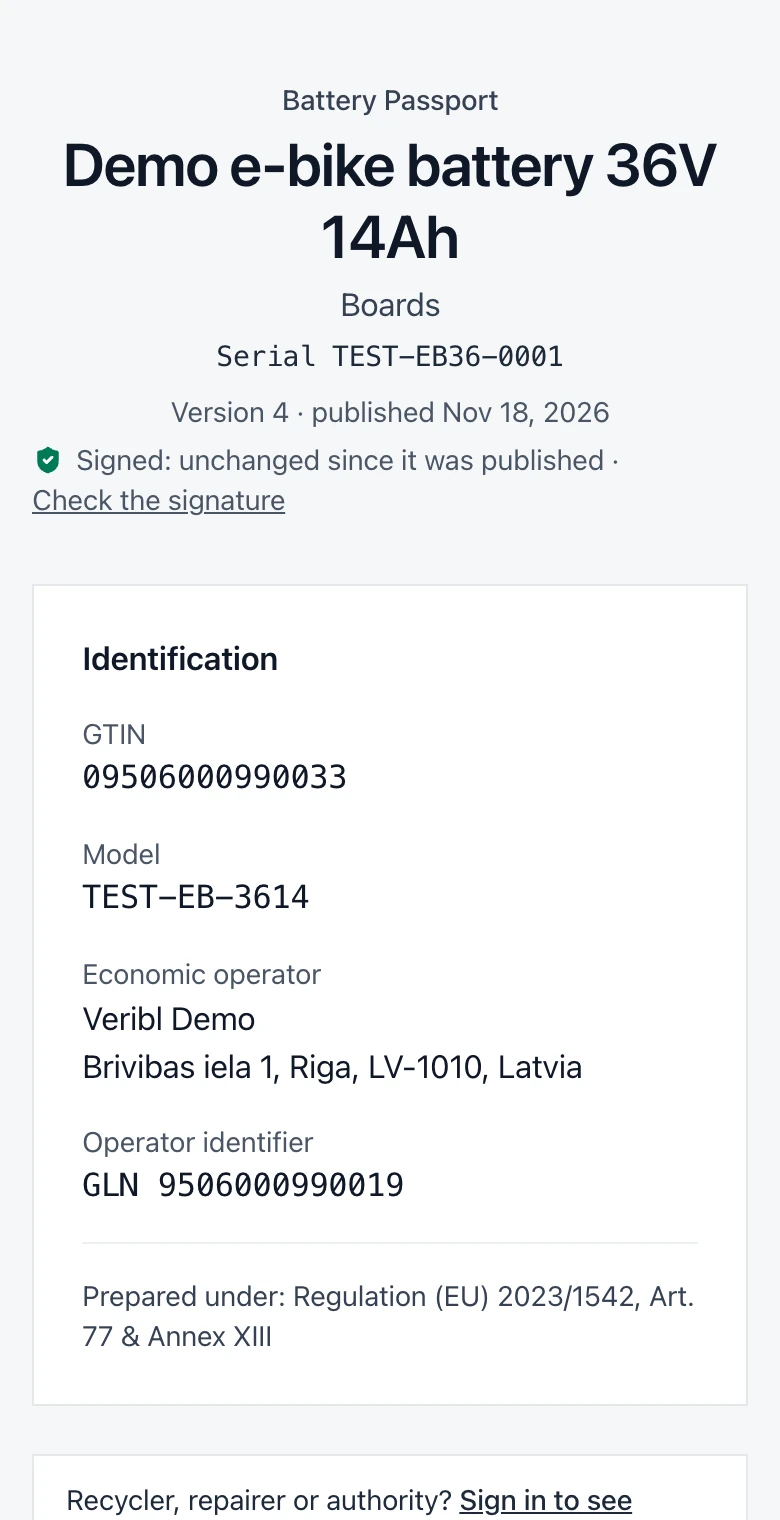
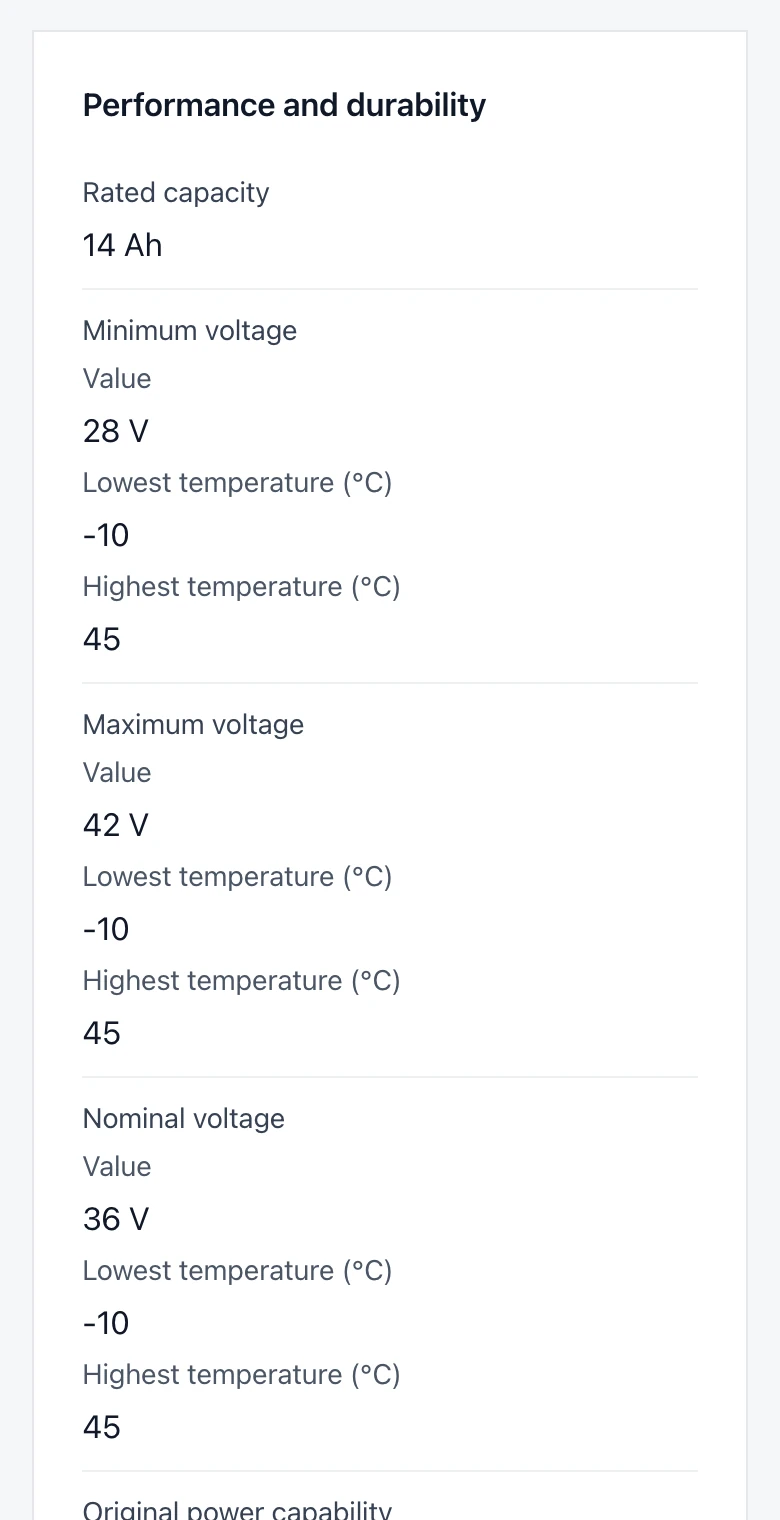
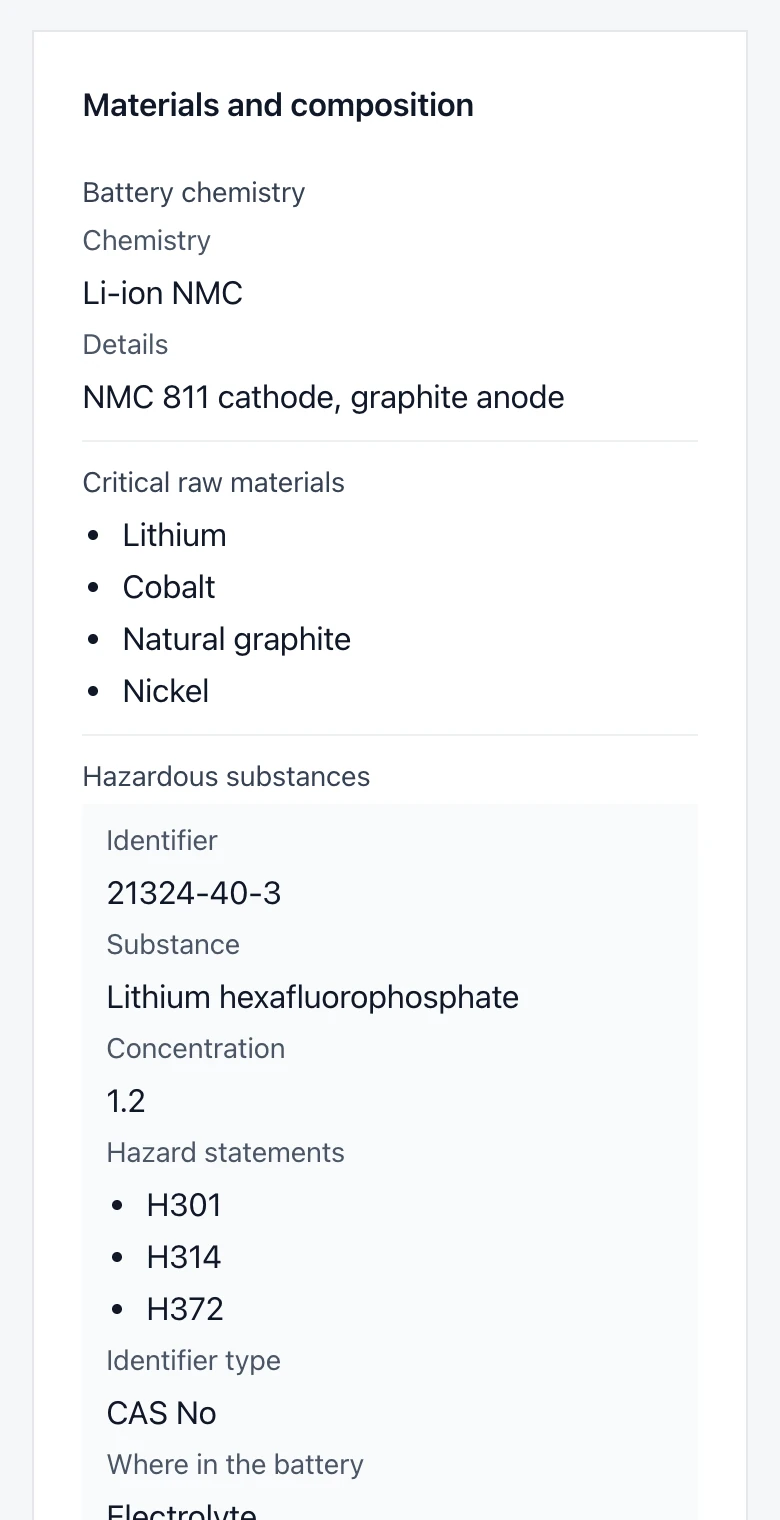
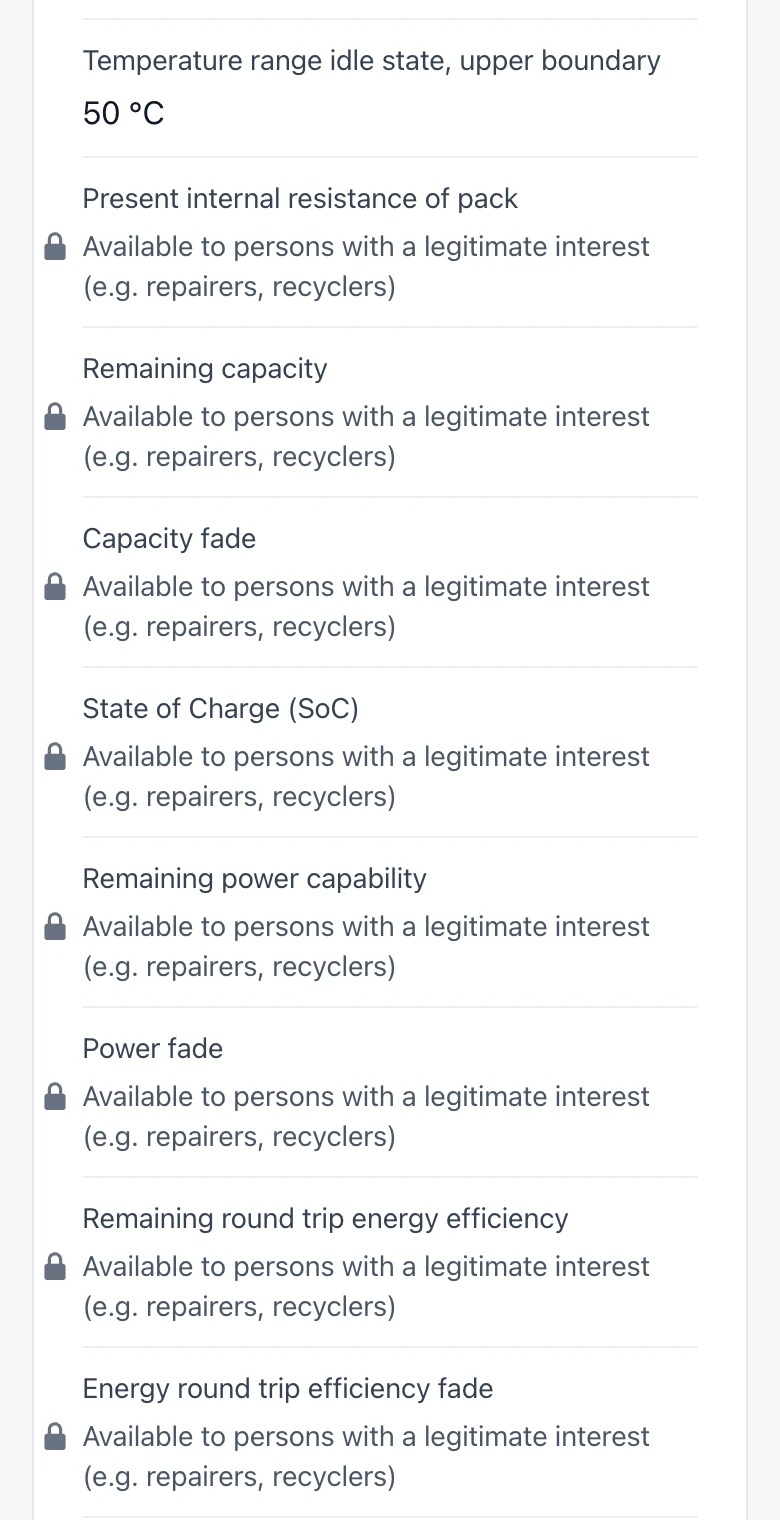
These are screenshots of the live passport of a Veribl demo e-bike battery (36 V, 14 Ah, Li-ion NMC 811), not mockups. The QR code on the battery opens it. The values are demo data; the fields are the ones the Battery Regulation asks for.
1Scan the QR code on the battery. The passport opens in the browser, no app needed.
2Performance and durability: capacity, voltages, power and cycle life.
3Chemistry, critical raw materials and hazardous substances.
4Restricted rows show a lock and who is allowed to see them.
Field by field: what it is, which rule asks for it and who can see it
The battery passport is required from February 18, 2027 for EV batteries, LMT batteries like this one, and industrial batteries over 2 kWh. Every field comes from Annex XIII of the Battery Regulation (EU) 2023/1542, which also sets who may see it. Carbon footprint, recycled content and due diligence apply from their own later dates.
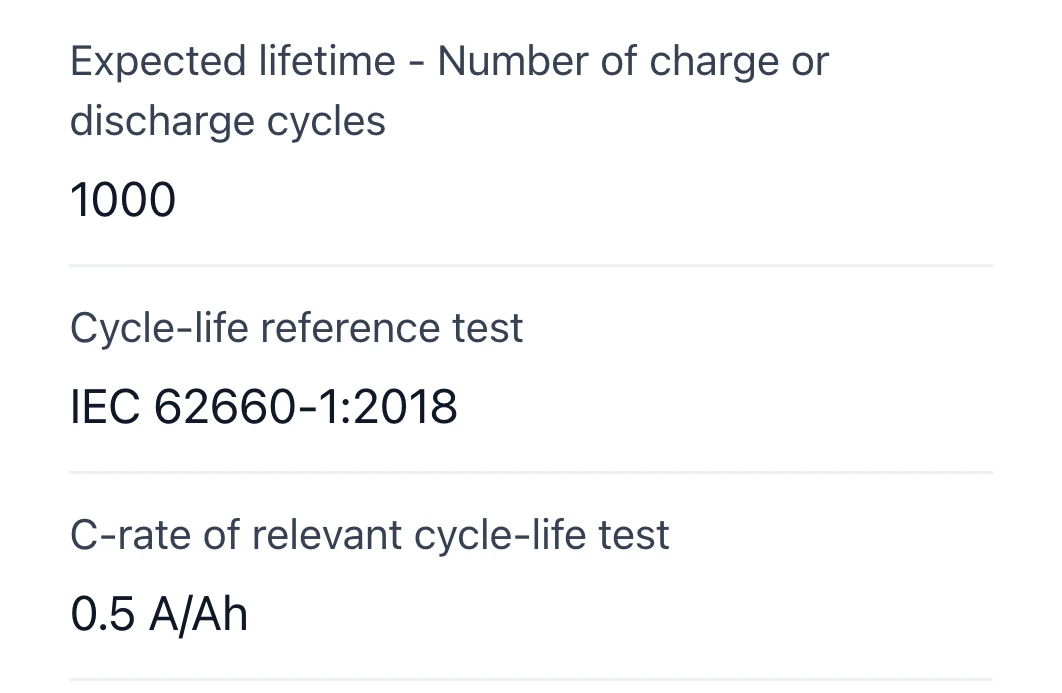
Performance and durability
PublicAnnex XIII 1(g)–(p)
How long the battery is built to last: 1,000 charge and discharge cycles, the test standard behind that number (IEC 62660-1:2018) and the C-rate of the test. The same group holds rated capacity (14 Ah), minimum, nominal and maximum voltage (28, 36 and 42 V), power capability, round-trip efficiency, self-discharge and internal resistance.
Which rule: Annex XIII point 1(g) to 1(p). Public, and required from February 18, 2027.
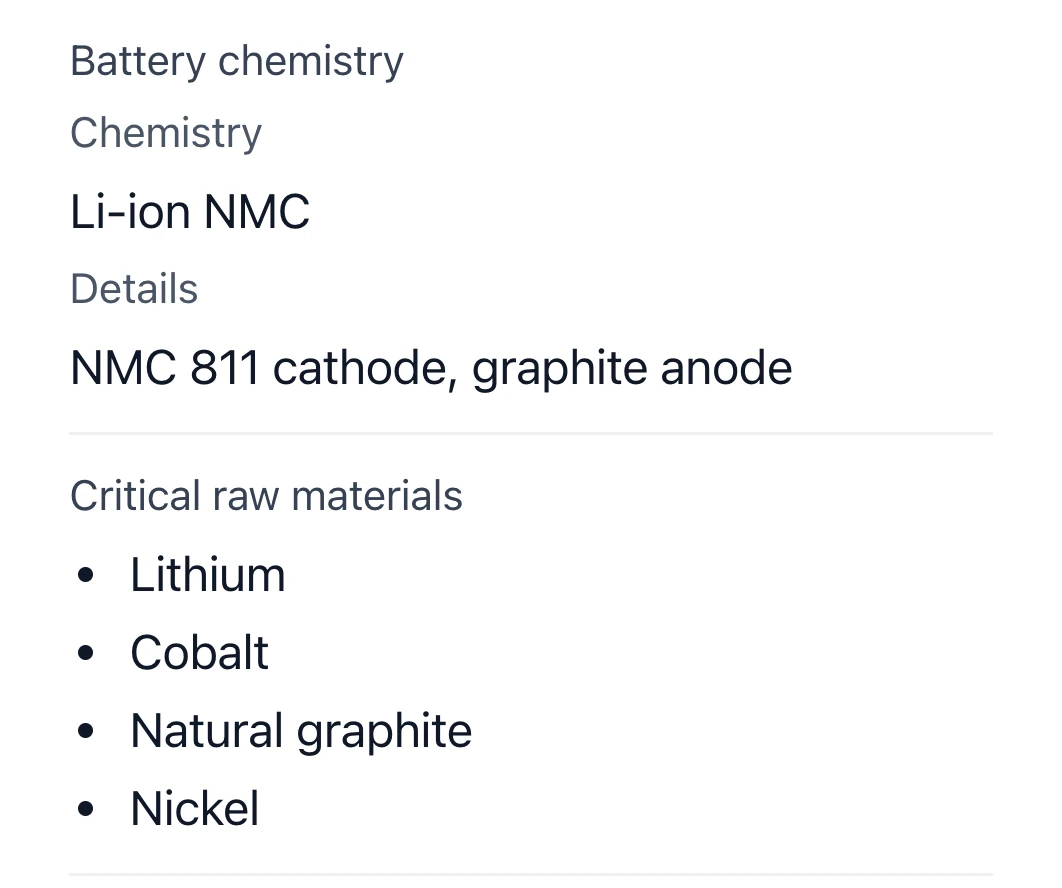
Chemistry and critical raw materials
PublicAnnex XIII 1(b)
Li-ion NMC, with an NMC 811 cathode and a graphite anode, and the critical raw materials in the battery: lithium, cobalt, natural graphite and nickel.
Which rule: Annex XIII point 1(b), with the general battery information of Annex VI Part A. Critical raw materials are listed when they are above 0.1% by weight. Public from February 18, 2027.
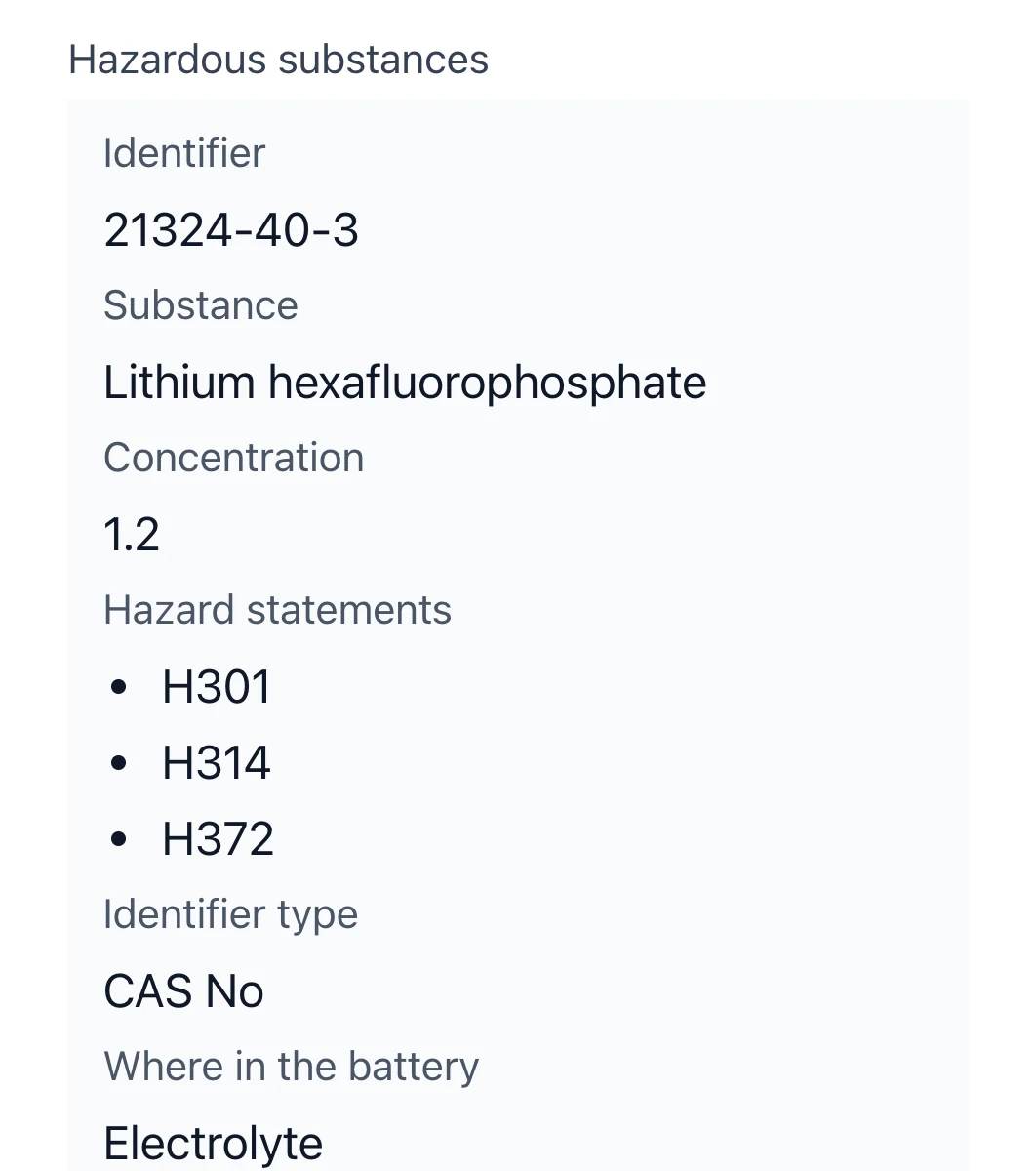
Hazardous substances
PublicAnnex XIII 1(b)
Each hazardous substance other than mercury, cadmium and lead, with its CAS number, concentration, hazard statements and where it sits in the battery. Here: lithium hexafluorophosphate in the electrolyte.
Which rule: Annex XIII point 1(b). Public. The detailed composition of the cathode, anode and electrolyte is a separate field (point 2(a)) for persons with a legitimate interest, so suppliers don’t have to publish their recipe.
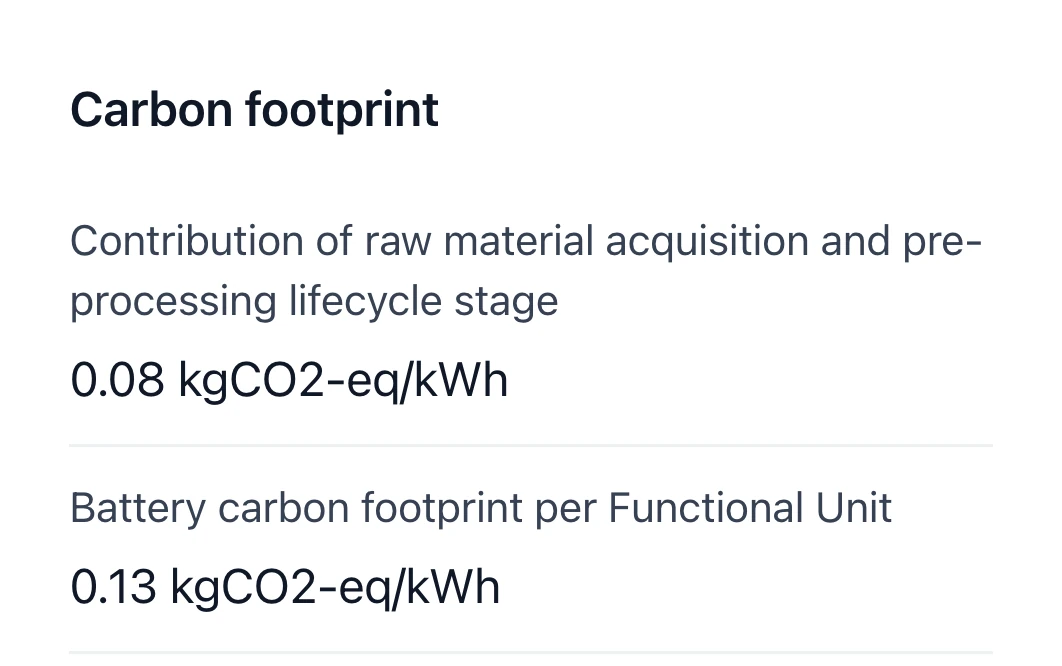
Carbon footprint
PublicLater dateAnnex XIII 1(c)
The carbon footprint per kWh over the battery’s life, the share of each life cycle stage, the performance class and a link to the public study. This demo shows 0.13 kg CO2e per kWh and class B.
Which rule: Annex XIII point 1(c) and Article 7. Not required on February 18, 2027: the date is set for each battery category by delegated acts. This demo fills it in already so you can see where it goes.
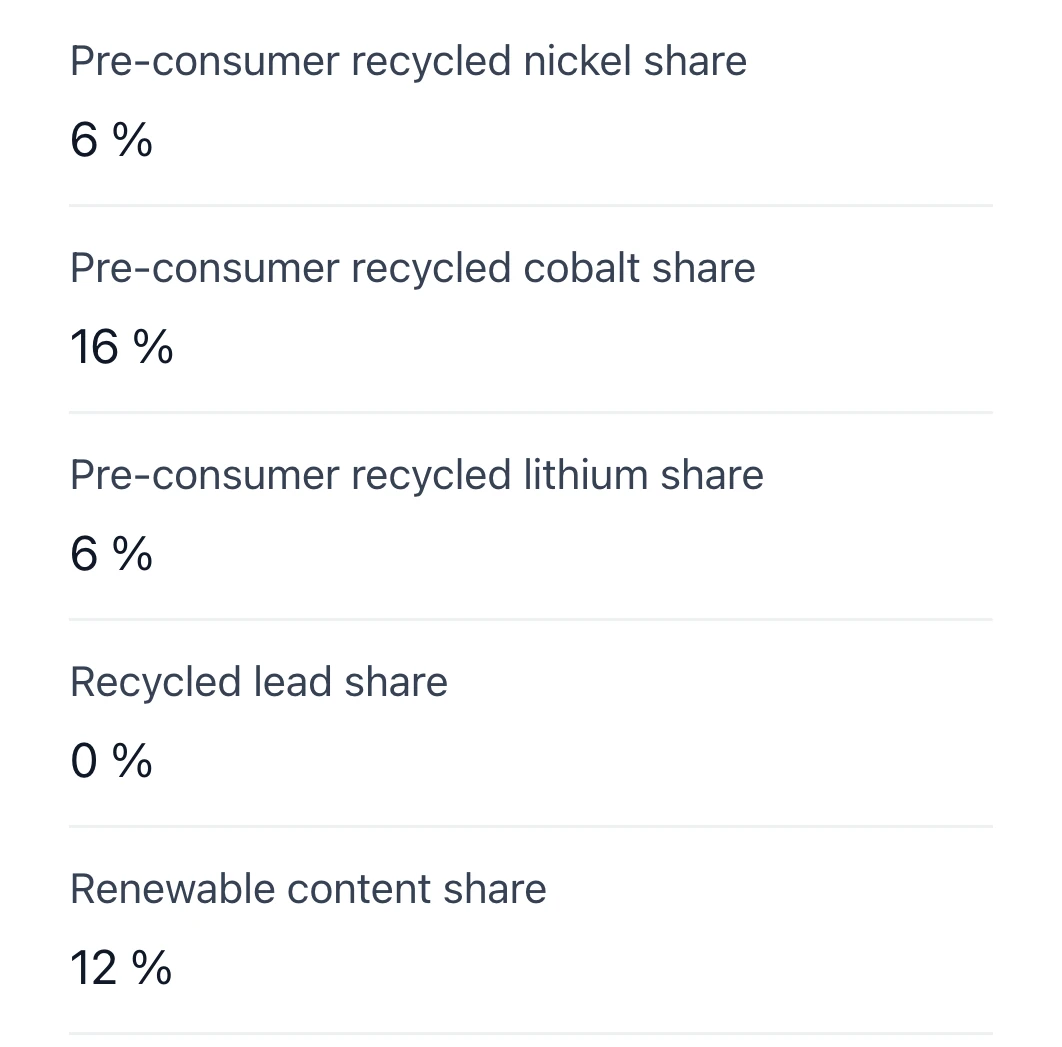
Recycled and renewable content
PublicAnnex XIII 1(e), 1(f)
The share of recycled nickel, cobalt, lithium and lead in the battery, and the share of renewable content.
Which rule: Recycled content is Annex XIII point 1(e), under Article 8, and applies from a later date. The renewable content share is point 1(f), public from February 18, 2027.
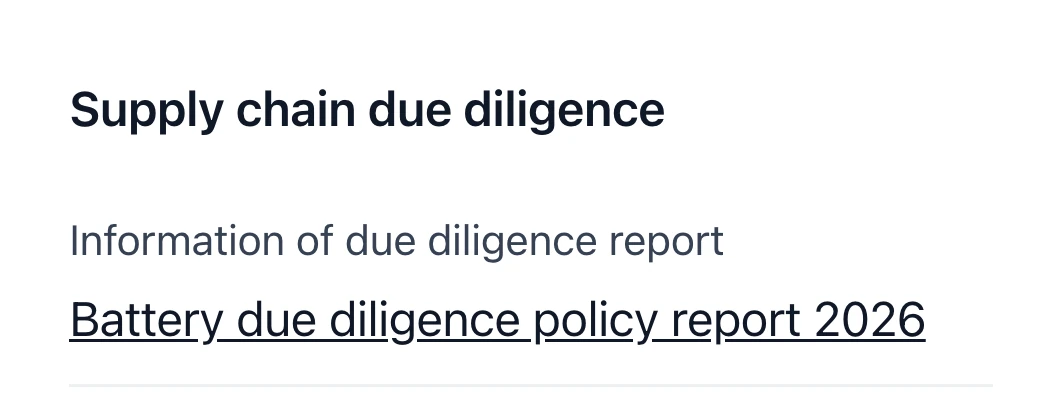
Supply chain due diligence
PublicFrom Aug 18, 2027Annex XIII 1(d)
A link to the due diligence policy report: how the company handles social and environmental risks in sourcing cobalt, natural graphite, lithium and nickel.
Which rule: Annex XIII point 1(d) and Article 52(3). Due diligence applies from August 18, 2027, after the two-year postponement in Regulation (EU) 2025/1561. Under Article 47, companies with a net turnover below EUR 40 million are outside its scope, unless they belong to a group above that limit.
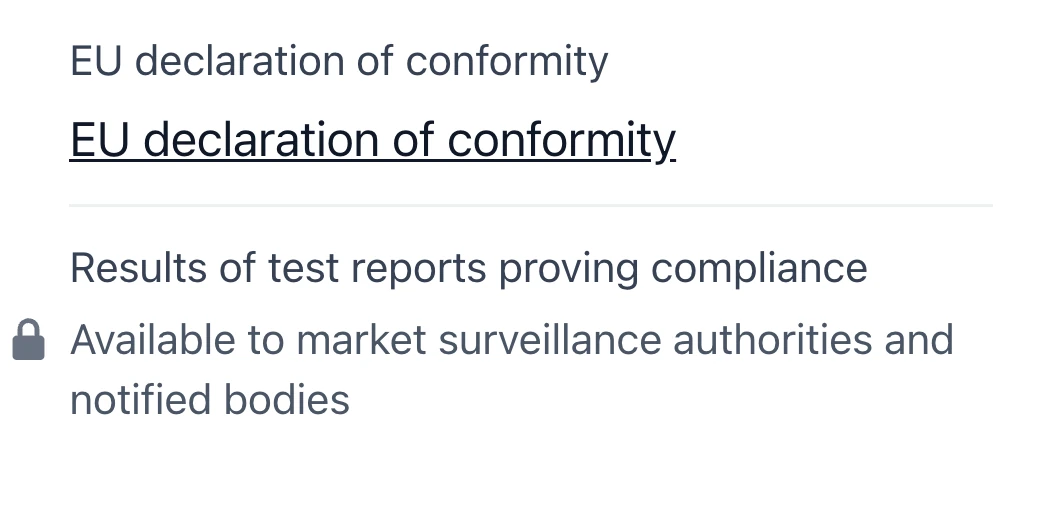
Declaration of conformity and test reports
PublicAuthorities onlyAnnex XIII 1(q), 1(r), 3
Anyone can open the EU declaration of conformity. The test reports behind it show a lock. The same section explains the labels and symbols on the battery and which extinguishing agent to use.
Which rule: The declaration is Annex XIII point 1(r) and the meaning of labels and symbols is 1(q), both public. Test reports proving compliance are point 3: for notified bodies, market surveillance authorities and the Commission.
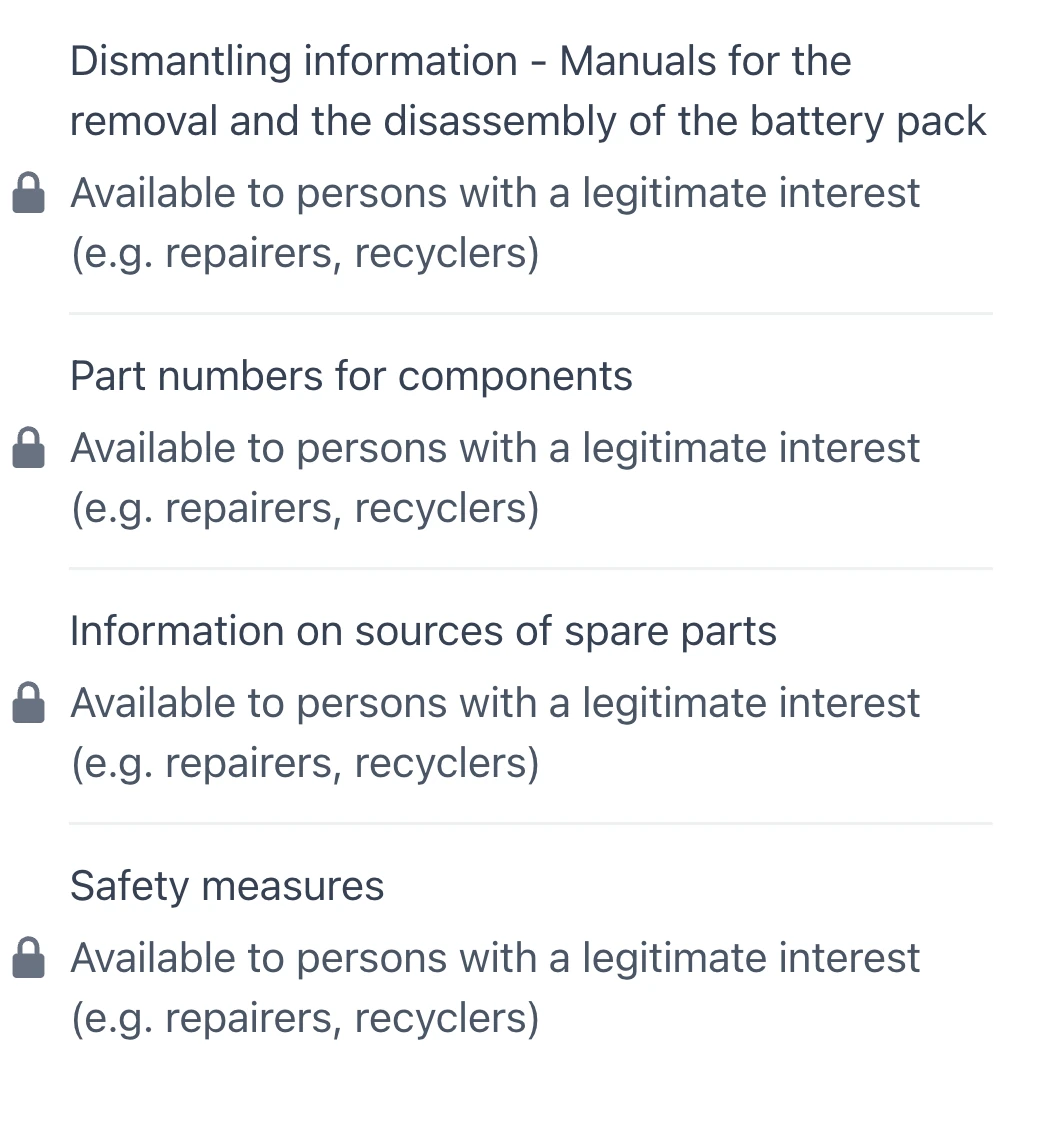
Dismantling, spare parts and safety
Legitimate interestAnnex XIII 2(a)–(d)
Manuals for removing and taking apart the pack, part numbers for components, where to get spare parts, and safety measures. These are what a repairer or recycler needs to open the battery safely.
Which rule: Annex XIII point 2(b) to 2(d), together with the detailed composition in 2(a). For persons with a legitimate interest, such as repairers, remanufacturers, second-life operators and recyclers, and for the Commission.
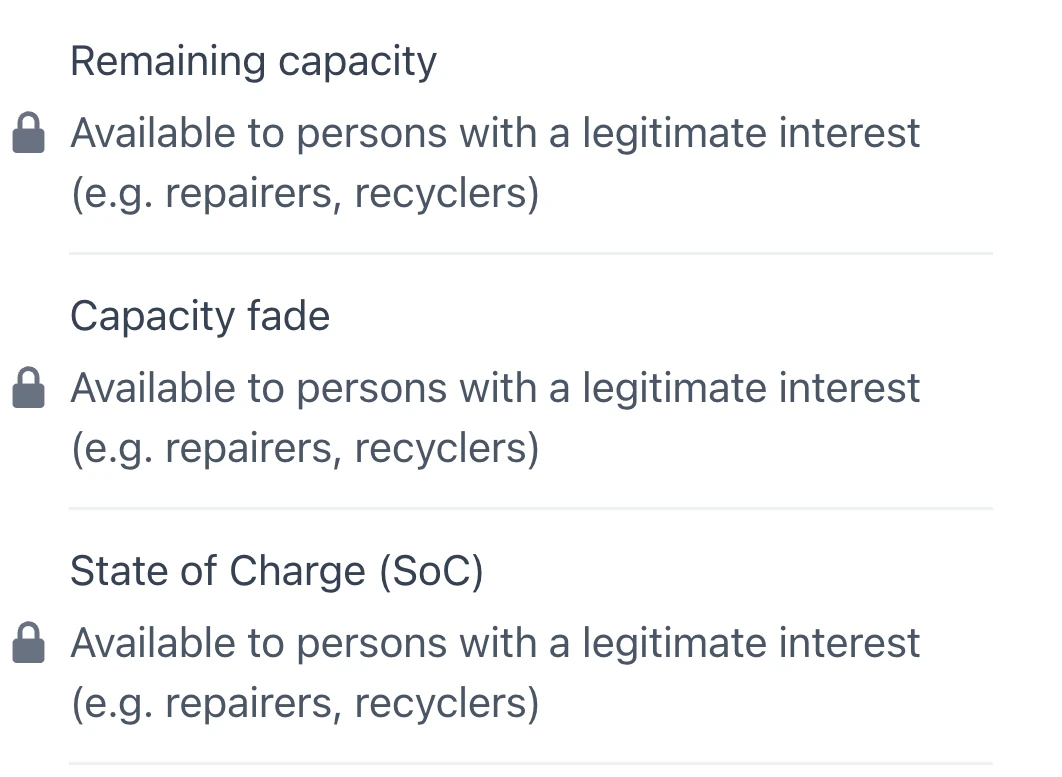
State of health and use of this battery
Legitimate interestAnnex XIII 4
Data about this one battery as it’s used: remaining capacity, capacity fade, state of charge, power fade, charging cycles, deep discharge and overcharge events, and accidents. Plus its status: original, repurposed, re-used, remanufactured or waste.
Which rule: Annex XIII point 4, for persons with a legitimate interest. This is why the passport is per battery, not per model: these values are different for every pack.
Every field group in the passport
The full list behind this passport, with its point in Annex XIII and who can see it.
| Field group | Annex XIII | Access | Required from |
|---|---|---|---|
| Manufacturer, category, place and date of manufacture, weight, warrantyPoint 1(a) via Annex VI Part A, 1(m) · Feb 18, 2027 | 1(a) via Annex VI Part A, 1(m) | Public | Feb 18, 2027 |
| Chemistry, hazardous substances, critical raw materialsPoint 1(b) · Feb 18, 2027 | 1(b) | Public | Feb 18, 2027 |
| Carbon footprint, performance class and declarationPoint 1(c) · Set per category | 1(c) | Public | Set per category |
| Due diligence policy reportPoint 1(d) · Aug 18, 2027 | 1(d) | Public | Aug 18, 2027 |
| Recycled content (cobalt, lithium, nickel, lead)Point 1(e) · Later | 1(e) | Public | Later |
| Renewable content sharePoint 1(f) · Feb 18, 2027 | 1(f) | Public | Feb 18, 2027 |
| Performance and durabilityPoint 1(g)–(p) · Feb 18, 2027 | 1(g)–(p) | Public | Feb 18, 2027 |
| Labels and symbols, EU declaration of conformityPoint 1(q), 1(r) · Feb 18, 2027 | 1(q), 1(r) | Public | Feb 18, 2027 |
| Waste prevention, collection and end of lifePoint 1(s) · Feb 18, 2027 | 1(s) | Public | Feb 18, 2027 |
| Detailed composition (cathode, anode, electrolyte)Point 2(a) · Feb 18, 2027 | 2(a) | Legitimate interest | Feb 18, 2027 |
| Spare parts, dismantling information, safety measuresPoint 2(b)–(d) · Feb 18, 2027 | 2(b)–(d) | Legitimate interest | Feb 18, 2027 |
| Test reports proving compliancePoint 3 · Feb 18, 2027 | 3 | Authorities only | Feb 18, 2027 |
| State of health, status and use of the individual batteryPoint 4 · Feb 18, 2027 | 4 | Legitimate interest | Feb 18, 2027 |
The same passport for machines
Recyclers, carmakers and authorities read passports with software, not on a phone. The same public data is published in three structured formats, each one live for this battery.
{
  "identification": {
    "category": "LMT",
    "chemistry": "Li-ion NMC, NMC 811 cathode, graphite anode",
    "identification": {
      "codes": [{ "key": "GTIN", "value": "09506000990033" }],
      "dataCarrier": { "carrierType": "QR" }
    }
  },
  "performance": {
    "rated": {
      "capacity": { "value": 14 },
      "voltage": { "min": 28, "max": 42, "nominal": 36 },
      "lifetime": {
        "cycleLifeTesting": { "cycles": 1000, "appliedChargeRate": 0.5 }
      }
    }
  },
  "materials": {
    "active": {
      "cobalt": { "recycled": 16, "critical": true },
      "lithium": { "recycled": 6, "critical": true },
      "nickel": { "recycled": 6, "critical": true }
    }
  },
  "sustainability": {
    "carbonFootprint": [{
      "lifecycle": "total",
      "value": 0.13,
      "unit": "kg CO2 / kWh",
      "performanceClass": "B"
    }]
  },
  "metadata": { "version": "4", "status": "approved" }
}- JSON-LDOpen the live file
- The passport page links it as “Machine-readable data”. Linked data with schema.org and UN/CEFACT terms, grouped like the passport: identity, performance, carbon footprint, materials, circularity, due diligence and labels.
- Catena-X Battery PassOpen the live file
- For automotive and industrial partners that exchange data in Catena-X. It conforms to the Catena-X Battery Pass model 6.0.0 (validated with the Eclipse ESMF SDK).
- Asset Administration Shell (AAS)Open the live file
- A shell for this battery with IDTA submodels for the battery nameplate, technical data, carbon footprint, material composition and circularity.
Every published version of the passport is signed, and the page links to a check that it hasn’t changed since it was published. Article 77 asks for passport data that is machine-readable, structured, searchable and based on open standards. New to the formats? Read about the Asset Administration Shell and DIN DKE SPEC 99100.
Who can see what
Unlike textiles, batteries already have access rules in law. Annex XIII splits the passport into three levels, and the Commission is preparing an implementing act that sets exactly who counts as having a legitimate interest.
Anyone who scans
Identification, chemistry, hazardous substances, critical raw materials, performance and durability, labels, the declaration of conformity and end-of-life information. Later also carbon footprint, recycled content and the due diligence report.
Repairers, remanufacturers, second-life operators, recyclers and the Commission
Detailed composition, spare parts, dismantling information and safety measures (point 2), and the state of health, status and use data of each battery (point 4).
Notified bodies, market surveillance authorities and the Commission
The test reports that prove the battery complies (point 3).

How restricted data works on this passport
Restricted rows aren’t hidden. The passport lists them with a lock and says who may see them, so a recycler knows the data exists. Near the top, a link reads “Recycler, repairer or authority? Sign in to see restricted information.” The brand gives access links to the repairers, recyclers and authorities it works with, and they sign in to see the restricted rows.
Scan it yourself
Point your phone camera at the code to open the live passport, or open it in your browser. It’s a GS1 Digital Link with the battery’s GTIN and serial number, the kind of code that goes on the battery itself.
Open the live passportBattery passport example FAQ
Questions people ask about battery passports. Get in touch.
Turn every product into your best channel.
 4.8/5 on G2